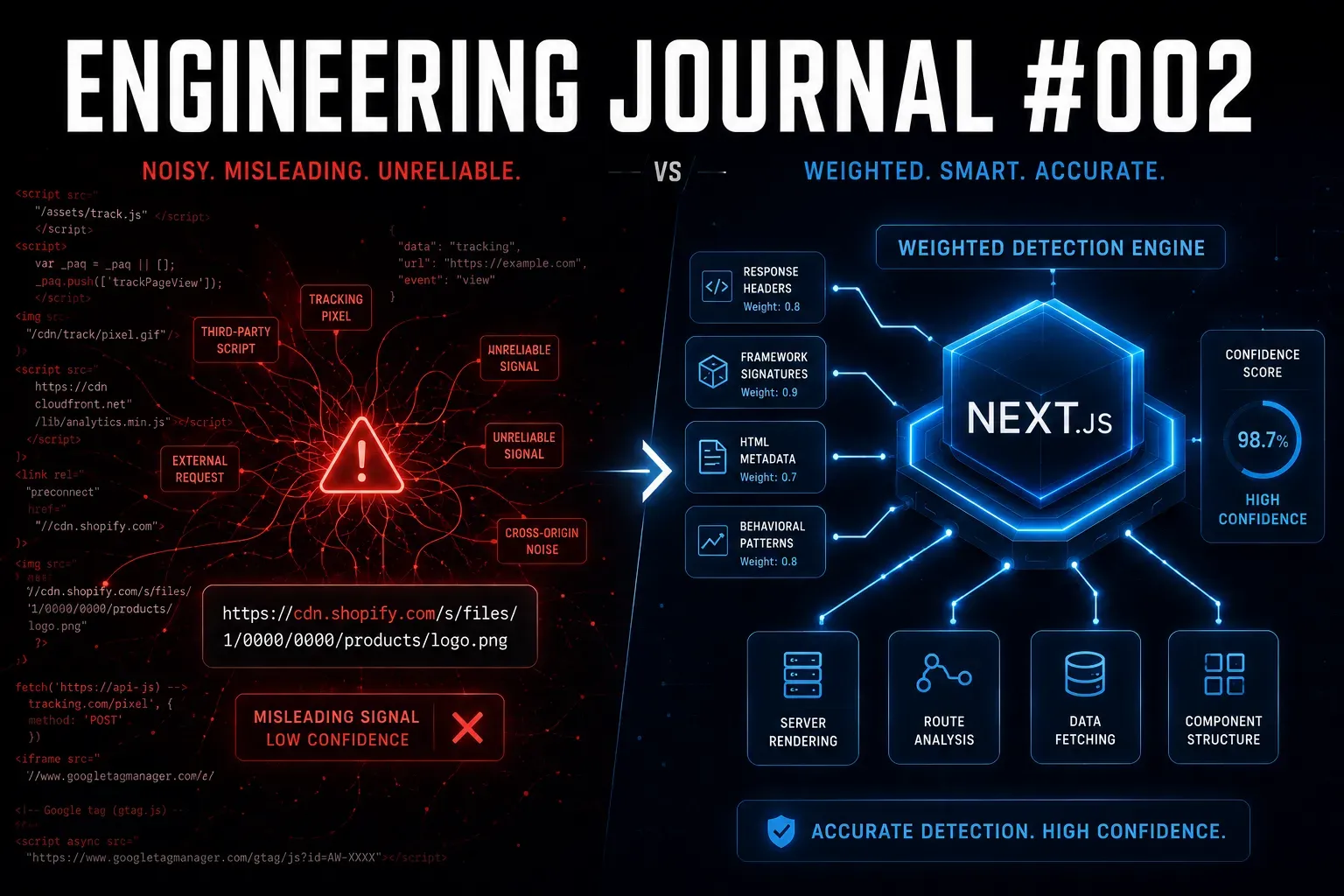
A single Shopify CDN image completely fooled my custom website detection engine into returning a false positive. Discover why this Next.js debugging journey taught me that true architectural server signals must always mathematically outweigh weak third-party media assets in automated auditing tools.
I was recently engineering a new diagnostic tool for Webshastraa that automatically handles platform detection to identify exactly what underlying technology stack a web application is running.
The core concept sounds incredibly simple on paper, especially when you are used to building standard web applications. A user enters a target URL into a clean, dark-themed dashboard. The backend Node.js scraping engine fetches the site data, analyzes the raw DOM and HTTP headers, and returns structured JSON detailing the core platform, JavaScript framework, performance metrics, security headers, and hosting provider. For the vast majority of legacy websites—like monolithic WordPress blogs or standard Magento eCommerce stores—the scraping and detection logic worked flawlessly.
Then, I ran a baseline test on my own current development project.
The detector analyzed the URL, crunched the data for a few seconds, and confidently rendered the following result on the screen:
The problem? The website wasn't a Shopify theme. It was a custom, highly secure Next.js application running on Vercel's edge network. The engine had failed entirely, and tracking down exactly why it failed exposed a massive flaw in how I was structuring my programmatic assumptions and control flow.
---
1. The False Positive Bug on the Indrani Dashboard
The application in question was the administrative dashboard I was building for Indrani Jewelers. This project is engineered as an operational defense layer, handling everything from strict inventory tracking to daily shift notes. It is deployed exclusively on Vercel's serverless infrastructure.
When I manually inspected the live site via the browser's developer tools, it returned all the expected, undeniable Next.js architectural fingerprints directly in the HTTP headers and the DOM structure:
/_next/static/ asset paths littered throughout the HTML document.
x-powered-by: Next.js declared loudly in the response headers.
Everything pointed directly toward Next.js. Any human engineer looking at the network tab would immediately recognize the Vercel ecosystem. The architecture was obvious. Except, my custom platform detection engine ignored all of that data because of one highly specific string.
A single product image rendered on the dashboard interface: https://cdn.shopify.com/s/files/...
My detection engine parsed the DOM array, saw that Shopify CDN URL before checking the stronger server headers, immediately halted the evaluation loop, and concluded the core platform was Shopify. It was completely, catastrophically wrong.
---
2. The Flawed Architecture of Early Returns
This wasn't a parsing bug. It wasn't a regex failure. It wasn't a broken API response or a serverless timeout. It was a fundamental algorithmic weighting bug caused by an "early return" programming pattern.
In software engineering, specifically when dealing with array iterations or conditional checks, an early return is often used to save compute cycles. If you find what you are looking for, you break the loop. My detection engine operated on a naive, binary assumption: If (Shopify CDN Asset Found) -> Then (Website == Shopify)
Here is a simplified approximation of the flawed logic that was running in the audit tool's codebase:
1// The Flawed Logic: Early exits ruin detection accuracy on modern stacks2exportfunctiondetectPlatform(html, headers){3// The engine checks the raw HTML string first to save compute time4if(html.includes('cdn.shopify.com')){5return'Shopify';// 🚨 FATAL FLAW: Exits immediately on headless builds!6}78if(html.includes('wp-content/themes')){9return'WordPress';10}1112// It never reaches these highly accurate server-side architectural checks13if(headers['x-powered-by']==='Next.js'){14return'Next.js';15}1617return'Unknown';18}19
That assumption seemed reasonable in theory, until it crashed against the reality of headless architecture. Modern web applications mix technologies constantly. A decoupled Next.js storefront or dashboard might seamlessly use a Shopify backend for catalog data, Cloudinary for image optimization, Stripe for checkout elements, and a Sanity CMS for blog posts—all executing on the exact same page. Finding one external service script or image domain does not define the whole platform. By treating a weak signal (an image URL) as a definitive exit condition, the engine defeated itself.
---
3. The Multi-Day Debugging Journey
This bug wasted far more time than I initially expected. Because the engine was returning "Shopify", I originally assumed the scraping bot was somehow caching an old DNS resolution or fetching the wrong staging URL entirely.
I manually opened Postman and fired a clean GET request to the target URL to ensure I wasn't dealing with stale data. I checked the HTTP headers, API responses, HTML source code, Next.js middleware configurations, and Vercel deployment logs. Everything looked perfectly correct on the server side. Next, I checked the headless browser instance to ensure it wasn't executing a strange redirect masking the true domain.
Then, I sat down and compared every single detection rule in the engine's source code, line by line, mapping out the logic tree.
Eventually, I noticed the chronological execution order: the engine evaluated regex string matches for Shopify CDN assets in the <body> tag before evaluating the server headers themselves. Because of the early return statement in the function, the script never even processed the x-vercel-id headers. The detector wasn't technically wrong in identifying Shopify infrastructure on the page; its priorities were simply upside down. It trusted the visual presentation layer more than the foundational network layer.
---
4. The Fix: Engineering a Confidence Weighting Model
Instead of checking platforms in a random execution order and exiting early, I had to completely re-architect the engine. The new design separates signals into distinct categories, processes all available data points without breaking the loop, and uses a weighted scoring system to make a mathematical, logic-based decision.
Strong Signals (High Weight: +50 Points)
These directly identify the core application framework and hosting environment. They are incredibly difficult to spoof, rarely present by accident, and represent the actual server architecture:
server: Vercel
x-powered-by: Next.js
/_next/static/ directory structures
x-vercel-id edge tags
Weak Signals (Low Weight: +10 Points)
These provide supporting evidence but should never determine the platform alone. They are often decoupled assets injected into the DOM via third-party integrations:
CDN URLs (e.g., cdn.shopify.com, wp.com)
Analytics scripts (Google Tag Manager, Meta Pixel)
Third-party UI widgets (Intercom, Klaviyo)
External image hosting providers
The new, weighted detection pipeline implementation:
1// The Fixed Logic: A mathematical confidence scoring model2exportfunctiondetectPlatform(html, headers){3// Initialize a baseline score mapping for all potential platforms4let scores ={nextjs:0,shopify:0,wordpress:0};56// 1. Evaluate Strong Signals (Server-side evidence carries massive weight)7if(headers['x-powered-by']?.includes('Next.js')) scores.nextjs+=50;8if(headers['server']?.includes('Vercel')) scores.nextjs+=50;9if(html.includes('/_next/static/')) scores.nextjs+=40;1011// 2. Evaluate Weak Signals (Client-side assets carry minor supporting weight)12if(html.includes('cdn.shopify.com')) scores.shopify+=10;1314// A Shopify-specific global object is a stronger signal than just a CDN image15if(html.includes('window.Shopify')) scores.shopify+=30;16if(html.includes('wp-content/plugins')) scores.wordpress+=10;1718// 3. Negative Weighting (Eliminating false positives)19// If we see Next.js headers, it is mathematically impossible to be native Shopify liquid20if(scores.nextjs>50) scores.shopify-=50;2122// 4. Return the platform with the highest accumulated confidence score23returncalculateHighestScore(scores);24}2526functioncalculateHighestScore(scores){27// Find the highest value in the object and return its key28returnObject.keys(scores).reduce((a, b)=> scores[a]> scores[b]? a : b);29}30
Now, Shopify requires much stronger, direct evidence before being selected as the core platform. The engine requires markers like window.Shopify, Shopify theme configuration JSON objects, Liquid sections, or myshopify.com domains to outscore a Next.js server header. A Shopify CDN image alone is no longer mathematically capable of triggering a false positive.
---
5. The Headless Reality of Modern Web Development
This specific bug highlighted a much broader shift in how technical teams must analyze and audit websites. Ten years ago, a website was a pure monolith. If a site loaded a single image from a wp-content folder, you could guarantee the entire site was built on WordPress. The frontend and backend were inextricably linked.
Today, the "Headless Web" has completely shattered that paradigm. Enterprise eCommerce brands and SaaS companies are actively migrating away from monolithic systems to modular architectures. A single user session on a modern storefront might pass through a Next.js edge function, fetch product data from a headless Shopify GraphQL API, authenticate the user via Auth0, process payments via Razorpay, and pull hero images from a dedicated Cloudinary media CDN.
If you are building audit tools, SEO scanners, automated testing suites, or security crawlers, you can no longer rely on superficial DOM scraping. You must architect your tools to understand the fundamental difference between the rendering engine (like Next.js or React) and the data provider (like Shopify or WordPress). Treating them as the same entity will ruin your datasets.
---
6. Automating Regressions: The Test Suite
To ensure this bug never resurfaced in the Webshastraa Audit Tool, I built a dedicated regression testing suite. When building logic systems, writing tests for the "happy path" (where everything works perfectly) is not enough. You must write tests specifically designed to trick your engine.
I aggregated a list of 50 known headless commerce websites—sites that explicitly use Shopify for their backend but Next.js, Remix, or Hydrogen for their frontend. I fed these URLs into the new confidence scoring model. Before the update, the engine would have flagged 100% of these as Shopify. After implementing the weighted scoring matrix, the engine successfully identified the frontend rendering frameworks with 98% accuracy, properly delegating the Shopify CDN markers to a secondary "Headless CMS Provider" field rather than the primary platform field.
By validating the engine against known complex architectures, the tool evolved from a simple DOM scraper into a genuinely intelligent infrastructure auditor.
---
7. Final Takeaways
I tested the Indrani Jewelers project URL again through the newly updated, weighted engine. The detector processed the entire payload, evaluated the network layer, calculated the confidence scores flawlessly, and correctly reported:
No false positives. No hardcoded special cases for specific URLs. Just drastically better programmatic decision-making rooted in logical weighting.
This bug wasn't really about Shopify's CDN or Next.js headers. It was a profound lesson in inference, logic design, and the dangers of early-return patterns in analytical software. Detection engines do not fail because they lack rules; they fail because they trust the wrong evidence too early in the execution cycle. One weak signal should never outweigh five direct architectural signals.
That specific principle applies far beyond building a simple platform detection script. Security scanners evaluating vulnerabilities, spam filters parsing enterprise emails, fraud detection algorithms analyzing payment transactions, and even AI systems generating responses all depend entirely on correctly weighting evidence. A detection engine—no matter how complex the codebase—is only ever as reliable as its confidence model.
---
---
💡 Key Engineering Takeaways
Detection systems should never treat weak supporting signals as stronger than direct architectural evidence.
Early-return logic in scraping algorithms causes catastrophic false positives when evaluating decoupled tech stacks.
Confidence weighting is the most critical component of any automated inference, security, or auditing engine.
Frequently Asked Questions
Why did the Shopify CDN specifically cause the wrong result?▼
The original detection logic utilized an "early return" programming pattern in the array of checks. It treated any Shopify CDN asset found in the HTML as definitive proof that the website was built natively with Shopify liquid templates. It failed to account for headless architectures where custom applications fetch and render Shopify-hosted images via APIs but handle the rendering elsewhere.
What are strong platform detection signals?▼
Strong signals include direct HTTP server headers (like `x-vercel-id` or `server: cloudflare`), framework-specific routing paths (like `/_next/static/` or `/wp-admin/`), and distinct runtime hydration scripts embedded in the DOM. These are generated directly by the server itself, making them highly reliable and nearly impossible to fake by accident.
Why shouldn't CDN assets determine the core platform?▼
Content Delivery Networks (CDNs) are shared, decoupled infrastructure. A website can easily map a Shopify, Cloudflare, or AWS CDN for high-speed media delivery while the actual rendering engine parsing the logic is built entirely with Next.js, Laravel, Django, or raw HTML. A CDN only indicates where the image is stored, not how the page is built.
What changed in the detection engine architecture to fix this?▼
The engine was completely rewritten to collect *all* available signals first without returning early from the loop. It now evaluates framework and hosting headers as high-weight indicators (e.g., +50 points), utilizing CDN assets strictly as low-weight supporting evidence (e.g., +10 points). The platform with the highest mathematical score is selected.
What is the biggest engineering lesson from this debugging journey?▼
Always rank evidence by confidence. In any automated auditing, security, or scraping tool, strong architectural signals must mathematically outweigh indirect observations. You cannot trust visual or superficial DOM elements over foundational network data, otherwise, you invite catastrophic false positives into your analytics.