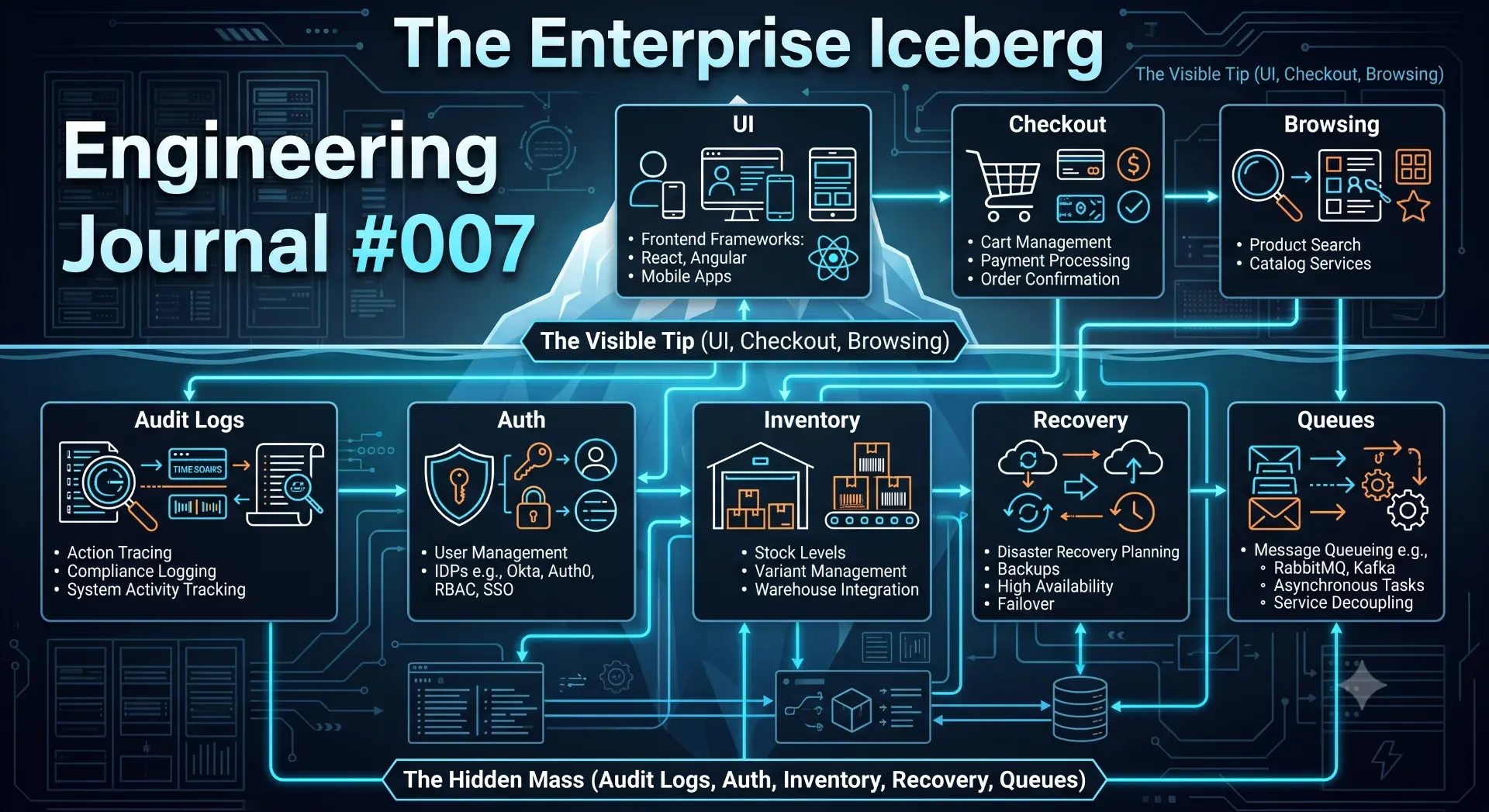
Customers only see the sleek interface. Engineers spend months building everything underneath it. Discover why robust enterprise software resembles an iceberg, prioritizing invisible backend systems for security, operations, and scalability.
What do you think an eCommerce website actually is?
If you ask most people to map out an online store, they will logically list the pages they click through: a homepage, a product catalog, a shopping cart, and a checkout screen. While that describes the visual journey, it completely ignores the reality of building complex business systems.
At Webshastraa, we engineer enterprise platforms, and we constantly have to explain this fundamental truth to technical founders: building the screens is the easy part. The screens are merely a skin. The real application is the massive, complex, and entirely invisible machinery operating underneath those screens.
This engineering journal strips away the frontend aesthetics to explore how real enterprise software is designed, why business systems are exponentially more complex than basic applications, and why the most critical parts of your software are the parts your customers will never see.
---
1. The Part Customers See
To a customer, a digital platform is a straightforward, linear experience. Their entire journey can be summarized in a simple flowchart:
Homepage → Browse → Checkout → Order Complete
They click a button, a loading spinner briefly appears, and they receive a confirmation email. From their perspective, that sequence is the software. They do not care about load balancing, database indexing, or background worker queues. They care about friction.
If everything works perfectly, the customer will never think about the software again. In software engineering, this is not a lack of appreciation—it is the definition of absolute success. Great software feels entirely invisible. The interface should feel so intuitive that the underlying complexity completely dissolves from the user's mind.
However, delivering that frictionless illusion requires a staggering amount of hidden engineering.
---
2. The Iceberg Beneath
Beneath those four or five customer-facing pages lies an entirely different world. To ensure that a single action—like placing an order or updating a profile—processes correctly, securely, and reliably, the architecture must orchestrate dozens of independent, isolated systems in the background.
When you invest in enterprise software, you are not buying the frontend buttons. You are buying the submerged mass of the iceberg. These systems include, but are not limited to:
Authentication & Authorization: Verifying who you are and what you are allowed to do.
Security & Threat Detection: Preventing malicious inputs and brute-force attacks.
Pricing Engines: Calculating complex tax rules, dynamic discounts, and currency conversions in real-time.
Inventory Management: Preventing race conditions so two people don't buy the last physical item simultaneously.
Audit History: Recording an immutable ledger of exactly who changed what, and when.
Notifications & Queues: Ensuring emails and SMS messages are delivered without slowing down the web request.
Search & Indexing: Parsing millions of records in milliseconds.
Reporting & Analytics: Aggregating data so the business can make financial decisions.
Backups & Recovery: Ensuring data is duplicated geographically to prevent catastrophic loss.
None of these systems directly generate top-line revenue on their own. Yet, every single one of them protects the business. The submerged mass of the iceberg is what prevents the company from sinking under the weight of its own scale.
---
3. Security Is Mostly Invisible
Many developers transitioning from simple websites to enterprise applications think security begins and ends at the login screen. In an enterprise environment, authentication is merely the introduction.
True enterprise security operates on the principle of Zero Trust. The system must inherently distrust every incoming request, even if the user is successfully logged in. Security at scale means checking granular permissions on every network request to ensure a standard employee cannot accidentally access administrative billing portals.
Most importantly, enterprise security relies on strict Audit History. Businesses rarely ask, "Did something change?" They ask, "Who changed this record at 2:00 PM yesterday, what was the previous value, and can we revert it immediately?"
Security is not just about keeping hackers out; it is about protecting the business from internal human error. It is about tracing actions, enforcing institutional trust, and ensuring that no data mutation occurs without a cryptographic fingerprint attached to it.
---
4. Enterprise Software Assumes Failure
This is the largest psychological shift required to build enterprise software: Junior engineers ask, "What happens if everything works perfectly?" Senior engineers ask, "What happens when this system inevitably fails?"
You must design for failure. You must assume that at some point, the database will temporarily lock, the payment gateway's API will go offline, the power will cut out mid-transaction, or a manager will upload a corrupted CSV file containing 10,000 malformed rows.
If a background system attempts to send a welcome email and the email provider's API returns a 500 Internal Server Error, the customer's checkout process should not crash. The application must fail gracefully. It should record the order, drop the email task into a retry queue, and deliver the email an hour later when the external service is restored.
Enterprise software is defined by its elasticity. It absorbs shocks, isolates failures, retries background tasks autonomously, and shields the end user from infrastructural chaos.
---
5. Operations Matter More Than Features
When people visualize software, they picture the consumer. But in enterprise systems, internal employees spend exponentially more time inside the application than any external customer ever will.
For every clean, minimal dashboard a customer sees, there is a dense, highly complex operational portal that internal teams stare at for eight hours a day. These employees rely heavily on:
Bulk data imports and automated validation.
Complex, filterable exports for financial reporting.
Work queues and shift handover notes.
Tools for processing refunds and handling customer disputes.
Internal communication layers and status flags.
A poorly designed administrative panel creates bottlenecks that scale linearly with the growth of the company. If it takes a customer support agent ten clicks to refund an order, a business processing a thousand orders a day will bleed money in wasted labor. The ultimate goal of an enterprise operations portal is to reduce human labor. The software should automate repetitive tasks and empower the staff to do their jobs seamlessly.
---
6. Enterprise Software Is About Confidence
The fundamental difference between demo software and production enterprise software comes down to optimization goals.
Demo software is built to prove that a concept works. It optimizes for features, speed of delivery, and visual impact. You click a button, and the right thing happens. It is impressive, but it is fragile.
Enterprise software is built to optimize for confidence.
It does not just prove that a feature works once during a presentation. It proves that the feature will keep working flawlessly after months of uptime, after hundreds of code deployments, after database migrations, and under the chaotic stress of thousands of concurrent users.
When a business trusts a piece of software to handle its payments, manage its sensitive client data, and run its daily operations, reliability is the product. You are not paying for the code; you are paying for the architectural certainty that the system will not collapse when the business scales.
---
7. Engineering Lessons
If you are an agency owner, a CTO, or an engineer transitioning into building larger systems, keep these practical architectural takeaways in mind:
Build for recovery: Assume networks will drop and humans will make catastrophic mistakes. Design systems that can self-heal, retry, and revert easily.
Automate repetitive work: If an operational task requires a human to do the exact same thing five times a day, it should be an automated background job.
Every important action should be traceable: Implement robust audit logging. State mutations without historical context will eventually become an operational nightmare.
Design around people, not databases: Do not force employees to adapt to your database schema. Shape the administrative UI to map perfectly to their actual business workflows.
The interface is the smallest part of enterprise software: Never budget or schedule a project based purely on the screens you can see. The invisible architecture will always consume the vast majority of your engineering resources.
---
Conclusion
Customers buy software because of what they can see. Businesses keep using software because of everything they can't.
The sleek homepage, the fast checkout, and the clean dashboard are vital for acquiring users, but they do not sustain a company. The invisible architecture—the security protocols, the idempotent background queues, the operational tools, and the audit logs—determines whether a system survives years of real-world use.
If you are building or buying custom software, look past the tip of the iceberg. The depth of the engineering beneath the surface is what will ultimately dictate the ceiling of your business.
The user interface is only the visible 10% of an application; the remaining 90% dictates operational survival.
Enterprise security assumes inevitable compromise and prioritizes granular auditing and rapid recovery.
Designing for failure using idempotent operations and fallback mechanisms is the hallmark of mature engineering.
Frequently Asked Questions
Why is enterprise software architecture more complicated than a standard website?▼
A standard website primarily serves read-only content. Enterprise software must securely process transactional data, orchestrate complex background logic, maintain strict audit trails, support internal business operations, and scale dynamically—all while assuming hardware or network failures are inevitable.
Why do enterprise systems invest so much engineering time into audit logs?▼
Accountability is mandatory in a corporate environment. Audit trails help security teams investigate mistakes, prevent malicious insider actions, ensure regulatory compliance, and understand exactly how, when, and by whom data was altered.
Why are admin panels often more complex than the main customer application?▼
While a customer might spend five minutes a month in an app to make a purchase, employees spend their entire workweek in the admin panel. These portals must handle bulk actions, data corrections, financial reporting, and complex workflows that require deep system access.
Why is reliability considered a primary feature in enterprise software?▼
When software runs a business, downtime equates directly to lost revenue and destroyed trust. Features become irrelevant if the system is offline. Therefore, architectural reliability—achieved through automated failovers and robust testing—is the most valuable feature a platform can offer.
Why do engineers prioritize "designing for failure" in enterprise operations?▼
In real-world distributed systems, failure is a mathematical certainty. Third-party APIs will go offline, networks will drop packets, and servers will overload. Designing for failure ensures that when these events occur, the software degrades gracefully, catches errors, and recovers without corrupting the database.