Why Vibe Coding Stops Working After 10,000 Lines
AI is a force multiplier, but only if you know enough to catch its mistakes. Discover why vibe coding collapses at scale and how to transition back to real engineering.
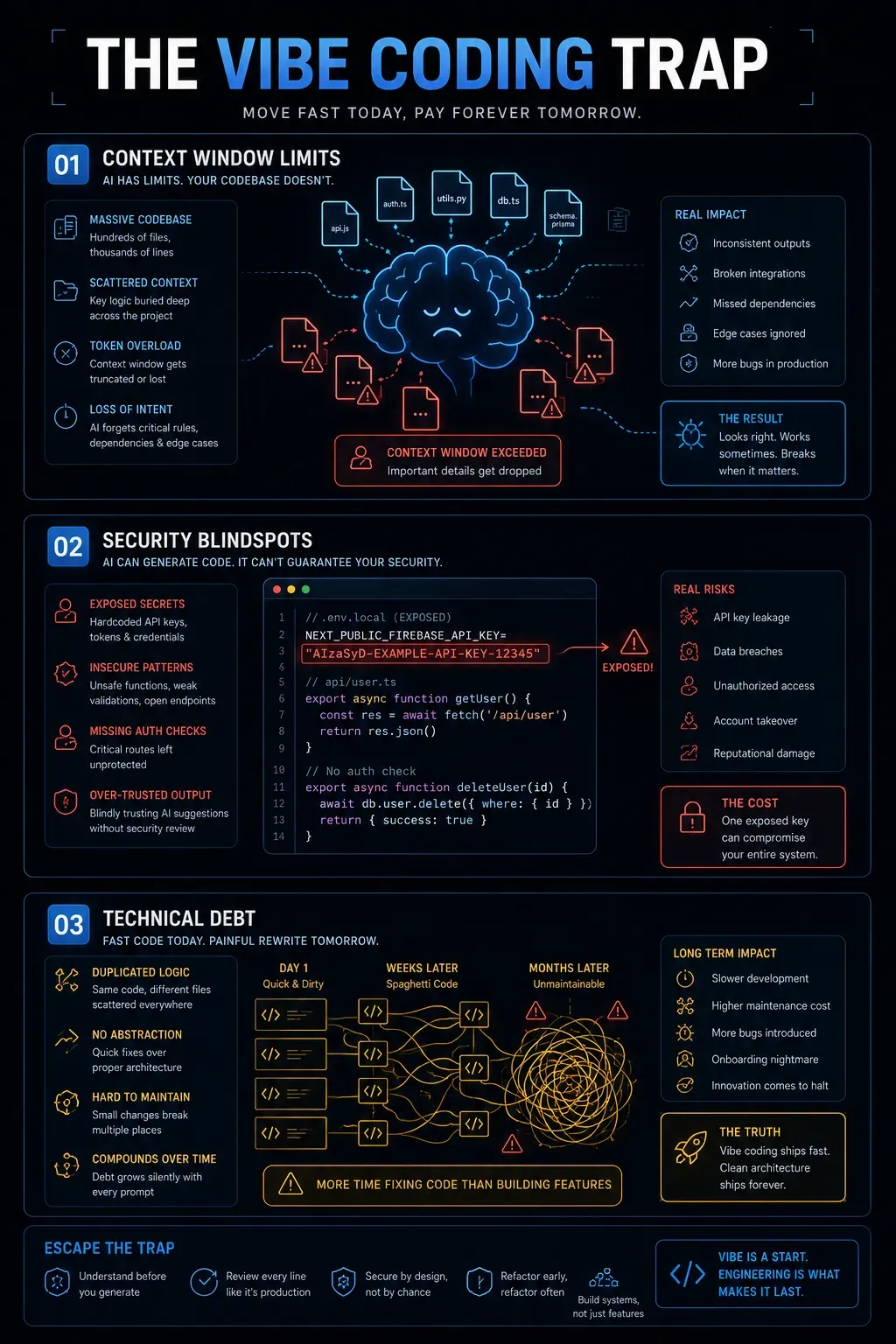
1. The Context Window Hallucination
The AI suddenly stops understanding how different parts of your application communicate, leading to broken imports, mismatched types, and endless logic loops.
Language models operate within a strict "context window." While modern context windows are massive, they cannot genuinely "understand" a complex, interconnected system architecture. When your application scales past 10,000 lines spread across dozens of interconnected directories, the AI begins losing the plot. It forgets how a server action in your backend folder maps to a client component in your UI folder, or it invents a database column that was never defined in your initial Prisma schema.
In practice, one issue we frequently encounter is developers asking an AI to update a user profile feature. The AI confidently generates the frontend component, but it imports a server-side authentication library directly into a
"use client" file. Suddenly, the Next.js build crashes with a fs module not found error. Because the developer is just vibe coding, they paste the error back into the AI. The AI apologizes and suggests a "fix" that completely bypasses the security middleware, leaving the route heavily exposed.You must treat AI as a localized tool, not a global architect. Restrict AI generation to isolated, modular functions and pure UI components. You, the human engineer, must explicitly define the global architecture, the data flow, and the security boundaries.
AI cannot architect a system; it can only predict the next token. You must maintain complete mental ownership of how data flows through your application.
2. The Confident Security Disaster
AI models confidently generate code that works perfectly on a functional level but introduces catastrophic security vulnerabilities, data leaks, and exposed credentials to the public web.
AI models prioritize fulfilling your prompt over securing your application. They are trained on millions of open-source repositories, many of which contain bad practices, outdated tutorials, and insecure configurations. If you ask an AI to "debug why my Firebase connection isn't working," it will often take the path of least resistance to get a successful connection, ignoring all modern security protocols.
This is the exact moment when vibe coding becomes dangerous. We frequently see developers ask an AI to fix a bug in a Next.js application, and the AI confidently outputs code that logs sensitive keys:
console.log("Firebase API Key:", process.env.NEXT_PUBLIC_FIREBASE_API_KEY);. While this might technically help you debug the environment variable in your local terminal, if this code ships to production inside a Client Component, it exposes your API keys to the browser console of every single user.Implement aggressive, automated security tooling in your CI/CD pipeline and never trust AI-generated code involving authentication, database connections, or environment variables. Just like following a rigorous Shopify SEO checklist 2026 is mandatory for protecting your eCommerce visibility, implementing strict security pipelines is mandatory for protecting AI-assisted coding.
AI is a force multiplier—but only if you know enough to catch its mistakes. You must possess the foundational software engineering knowledge to audit the code it produces before it reaches production.
3. The Technical Debt Avalanche
Vibe coding produces technical debt at an unprecedented speed, making the codebase entirely unmaintainable after just a few weeks of rapid development.
When an AI generates code, it rarely considers reusability, DRY principles, or long-term maintainability unless explicitly and aggressively prompted to do so. The AI has no memory of the component it built for you yesterday. If you ask an AI to build three different forms, it will likely generate three entirely separate components with duplicated state management, validation logic, and API fetching patterns.
You ask the AI to build a "Contact Us" form, and a week later, you ask it to build a "Newsletter Signup" form. Instead of creating a reusable
<Input /> component or a centralized validation schema, the AI writes two massive, 400-line monolithic files. When you later decide to change the styling of your input fields or update your error handling logic, you have to manually hunt down and update 15 different files. This level of unoptimized bloat is a primary reason why inexperienced developers make severe next.js hosting mistakes, creating massive bundle sizes that ruin server performance.You must aggressively refactor AI-generated code immediately after it works. Do not accept the first output as the final production code. Extract monolithic files down into smaller pieces, move duplicated API calls into utility folders, and enforce strict TypeScript interfaces.
| Codebase Metric | AI "Vibe Coding" Output | Human-Refactored Engineering |
|---|---|---|
| Component Structure | Monolithic (500+ lines per file) | Modular (Reusable sub-components) |
| Type Safety | Uses any or implicit typing | Strict TypeScript interfaces |
| State Management | Duplicated useState hooks | Centralized context or reducers |
| Maintainability | Extremely brittle | Highly scalable |
Vibe coding creates code. Engineering creates architecture. You must actively refactor AI output to prevent your project from collapsing into unmaintainable spaghetti code.
4. Edge Case Blindness and Error Handling
AI models optimize heavily for the "happy path" and frequently ignore complex edge cases, error boundaries, and realistic loading states.
When you prompt an AI to "build a login screen," it assumes the user will enter the correct password and the server will respond instantly. It rarely considers what happens if the network drops mid-request, if the database connection times out, or if the user clicks the submit button five times in rapid succession.
A common mistake developers make is trusting an AI to generate a shopping cart update function. The AI builds it, and it works perfectly on your fast local machine. But in production, a user on a slow 3G connection clicks "Add to Cart." Because the AI didn't implement optimistic UI updates, loading state disablements, or debounce logic, the user assumes the button didn't work and clicks it three more times. They end up with four items in their cart and abandon the checkout entirely.
You must actively prompt the AI (or manually code) defensive programming patterns. Every piece of interactive UI must account for latency, server errors, and malicious inputs.
Production software lives in the edge cases. You cannot rely on an AI to anticipate the chaotic reality of actual users interacting with your platform over unstable networks.
5. The Loss of Mental Mastery
Relying entirely on vibe coding degrades your own problem-solving skills and leaves you completely helpless when the AI inevitably fails to fix a complex bug.
When you outsource the "struggle" of debugging to an AI, you bypass the cognitive learning process. If you don't understand why a Next.js caching issue occurs, and you simply paste the error into ChatGPT until it spits out a fix, you haven't actually learned anything. When the application reaches 10,000 lines and the AI is completely lost in the context window, you will be too.
Your application suddenly starts throwing a cryptic
Minified React error #418. Because you vibe coded the last 50 commits, you have absolutely no mental map of the recent changes. You paste the error into the AI, but it suggests checking a file that hasn't changed in months. You are now completely paralyzed. You have built a machine you do not understand how to operate, making it impossible to reduce nextjs hosting costs or debug deployment crashes.Use AI as a specialized tutor, not just a blind typist. When an AI provides a solution, do not copy and paste it until you can explain exactly how it works.
- Ask the AI to explain why it chose a specific architectural pattern.
- Read the official documentation for the APIs the AI suggests.
- Write complex business logic yourself, using the AI only for boilerplate generation, UI scaffolding, and rubber-duck debugging.
The ultimate value of a software engineer is not the ability to type code quickly; it is the ability to mentally model complex systems and solve novel problems. Do not let AI atrophy your most valuable asset.
Call to Action
Did your AI-generated prototype hit a wall? If your codebase is struggling with performance, security vulnerabilities, or unmaintainable architecture, you need real engineering. Get a Speed Audit from the engineering team at Webshastraa today.
Frequently Asked Questions
What exactly is "vibe coding"?
Vibe coding is a modern colloquial term for building software by heavily relying on AI generation (like GitHub Copilot, Claude, or ChatGPT) using natural language prompts, often with a focus on speed and immediate results rather than strict architectural planning or deep technical understanding.
Why does AI struggle with large codebases?
AI models operate within a strict "context window," which limits how much code they can process at once. When a project scales past thousands of lines spread across multiple files, the AI loses track of how different components, state managers, and database schemas connect, leading to hallucinated variables and broken logic.
Is it dangerous to let AI write security or authentication logic?
Yes, it is extremely dangerous. AI models optimize for providing a working answer quickly, not securely. They will often suggest bypassing security protocols, hardcoding API keys, or logging sensitive environment variables just to make a feature "work." You must always manually audit AI-generated security code.
How can I use AI effectively without creating technical debt?
Use AI to generate isolated, "dumb" UI components, write repetitive boilerplate code, or explain complex concepts. However, you must manually define the system architecture, enforce strict typing, manage the data flow, and aggressively refactor the AI's output to keep the codebase modular and DRY (Don't Repeat Yourself).
Will AI replace software engineers?
AI replaces the mechanical *typing* aspect of coding, not the *engineering* aspect. As AI lowers the barrier to generating simple code, the value of developers who can architect complex systems, ensure strict security compliance, and debug issues that AI cannot comprehend will only increase exponentially.
Feedback