Next.js vs Shopify: Why Custom Architectures Beat App Ecosystems
Relying on Shopify apps degrades site speed and inflates monthly operational costs. This technical guide explains exactly how a custom Next.js eCommerce architecture resolves infrastructure friction, maximizes conversion rates, and eliminates third-party dependency.
1. The Third-Party App Performance Penalty
Shopify storefronts become painfully slow as the business adds functionality. Time to Interactive (TTI) metrics surge, and Core Web Vitals fail across the board.
Shopify apps function by injecting third-party JavaScript files directly into your
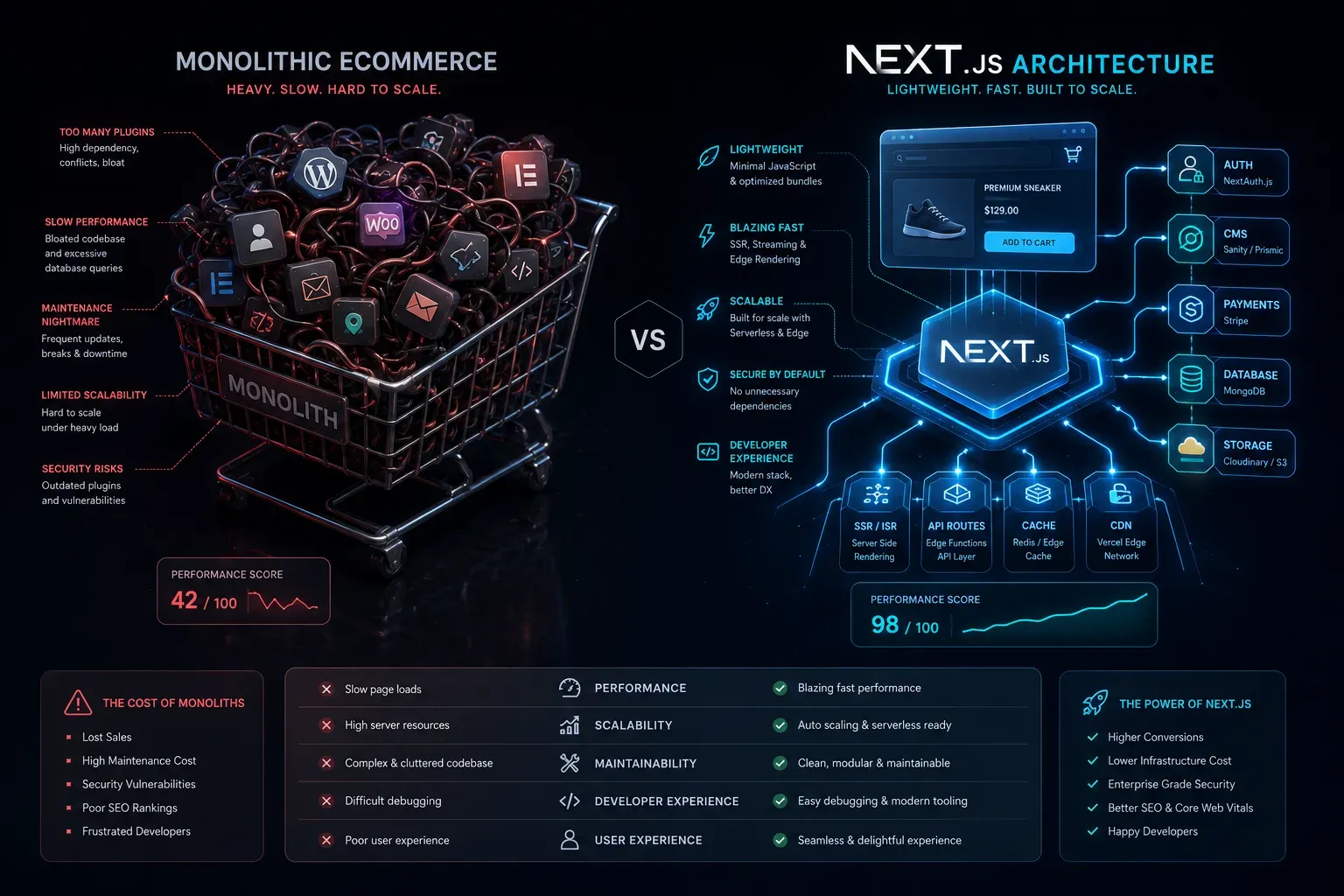
theme.liquid document head. Because these scripts load from external servers and execute on the client's browser, they block the main rendering thread. The browser cannot paint the visual product page until the review widget, the loyalty program tracker, and the analytics pixels finish executing.We frequently audit merchants running 15+ Shopify apps. Their Largest Contentful Paint (LCP) often spikes past 6 seconds on mobile 3G networks. The business attempts to optimize images, but the primary bottleneck remains the megabytes of third-party JavaScript executing on the client device.
Migrate to Next.js and utilize React Server Components. Instead of loading an external review widget app via client-side JavaScript, Next.js allows you to query your database for reviews directly on the server. You compile the reviews into static HTML at the edge and send zero JavaScript to the client browser.
Controlling your own render pipeline allows you to shift heavy logic to the server, protecting your Core Web Vitals and ensuring your catalog loads instantly.
2. Monthly Recurring Revenue (MRR) App Bloat
Scaling a Shopify store results in spiraling, unpredictable operational costs that drain profit margins.
The Shopify ecosystem relies on usage-based MRR (Monthly Recurring Revenue) apps. As your revenue and traffic grow, third-party apps for search, email, subscriptions, and reviews automatically upgrade you to enterprise pricing tiers. You end up paying thousands of dollars monthly simply to maintain baseline functionality.
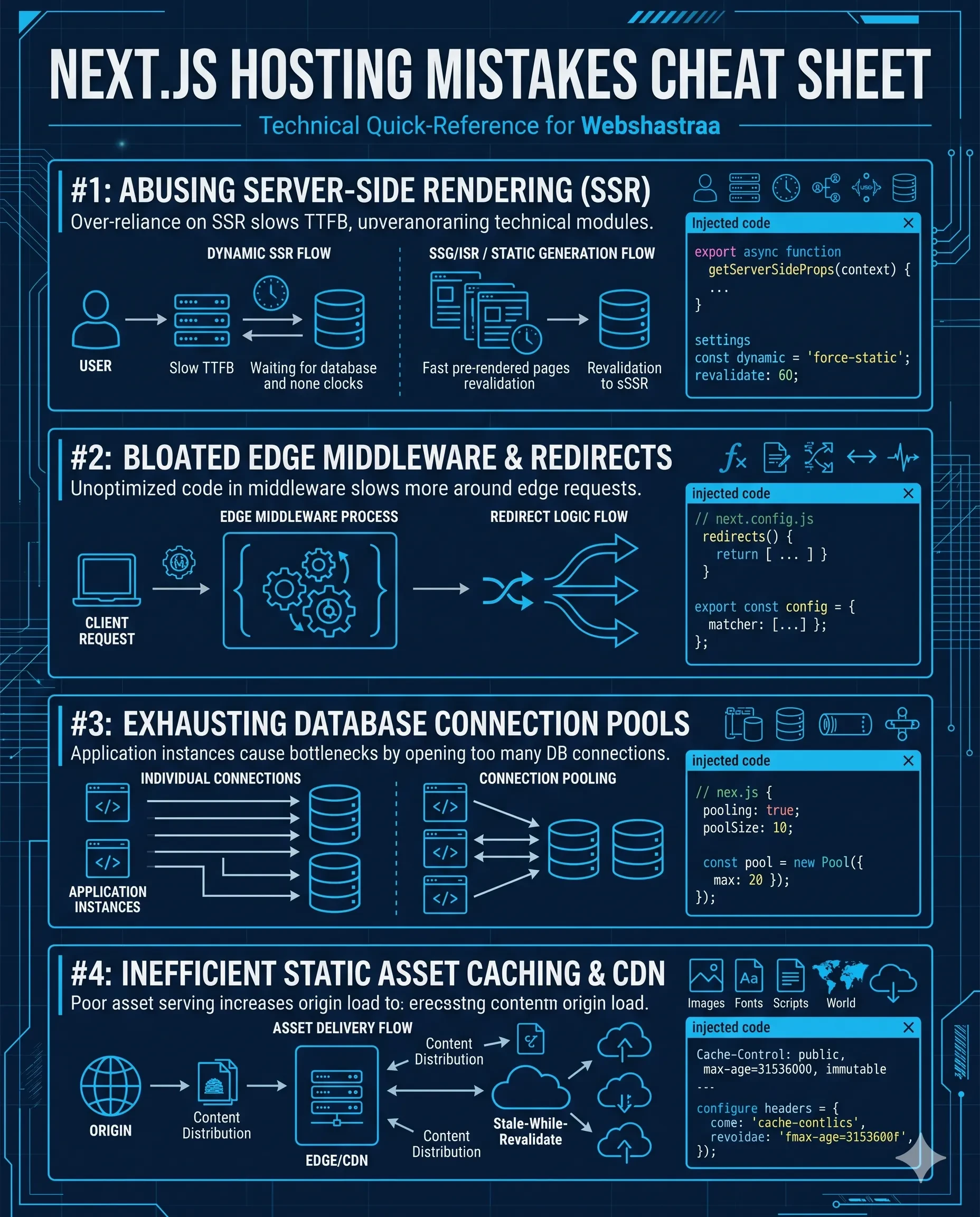
A client scaling past $5M in annual revenue suddenly incurs $2,500/month in app fees strictly for faceted search, product bundles, and custom discounts. Over three years, that is $90,000 in rented software. Furthermore, poorly coded apps often trigger infrastructure spikes; teams must carefully audit their code to reduce nextjs hosting costs if they migrate, but the baseline hosting is fundamentally cheaper than app subscriptions.
Building custom features in a Next.js environment backed by a PostgreSQL database allows you to own your logic. Once a feature (like product bundling) is engineered, it costs nothing to maintain operationally, regardless of how many orders you process.
| Infrastructure Component | Shopify + App Ecosystem | Custom Next.js + DB |
|---|---|---|
| Search & Filtering | $300/mo (Algolia/Searchanise) | Included (Postgres Full-Text Search) |
| Product Bundles | $150/mo (Recharge/Bundle App) | Included (Custom Prisma Schema) |
| B2B Wholesale Logic | $2,000/mo (Shopify Plus required) | Included (Role-based Auth in Next.js) |
| Server/Hosting | $299/mo (Advanced Tier) | ~$50/mo (Vercel + Supabase) |
Owning your infrastructure converts compounding monthly operational expenses into a capitalized business asset that scales infinitely without a pricing penalty.
3. Rigid SEO and URL Architecture
Advanced SEO strategies fail because merchants cannot control their exact URL paths or dynamic metadata injection.
Shopify hardcodes routing logic into its core platform. You are forced to use
/products/ for items and /pages/ for content. If you want a perfectly flat URL structure (e.g., store.com/red-leather-sofa), the platform strictly prevents it.When implementing international SEO, trying to map specific localized URLs fails in standard Shopify, leading to duplicate content issues that require extensive workarounds. While we highlight several mitigation strategies in our Shopify SEO checklist 2026, true architectural freedom is impossible on a closed platform.
The Next.js App Router utilizes dynamic routes (
[...slug]). You define the exact URL paths mapping to your canonical strategy. Combine this with the server-side generateMetadata API, and you achieve absolute programmatic control over search engine indexing.Total control over URL routing and server-rendered metadata ensures search engines index your catalog exactly how you intend, maximizing organic visibility.
4. Checkout Customization and Conversion Friction
Merchants cannot optimize the most critical part of their funnel: the checkout experience.
Shopify explicitly locks down the checkout page (
checkout.liquid) for security and PCI compliance reasons. Unless you upgrade to the highly expensive Shopify Plus tier, you cannot alter the checkout logic, add custom fields, or change the multi-step flow.A B2B manufacturer needs a multi-step checkout workflow featuring custom quote approvals, file uploads for tax exemptions, and net-30 payment terms. Standard Shopify completely prevents this business logic. Attempting to hack it with draft orders and external apps causes immense friction, leading to abandoned carts.
Decoupled Next.js architectures use headless APIs (like Stripe Elements or a headless Shopify Checkout API) to construct completely bespoke, single-page checkouts. You control every React component, allowing you to inject custom business logic directly into the payment flow.
Removing checkout friction and aligning the payment flow precisely with your unique business model directly increases top-line conversion rates.
5. Complex Catalog Data Limitations
Businesses with complex, highly configurable products frequently hit hard platform data limits, preventing them from selling their entire catalog online.
Legacy database structures within the Shopify core platform dictate strict data models. Shopify restricts product catalogs to exactly 100 variants and only 3 options (e.g., Size, Color, Material) per product.
A furniture retailer selling custom sofas needs 5 fabric types, 10 colors, and 4 leg styles—creating 200 possible combinations for a single SKU. Because Shopify restricts this to 100 variants, the merchant must split the product into two separate listings or rely on heavy, error-prone third-party "Product Options" apps. These apps often fail to sync correctly with warehouse inventory software.
A custom Next.js storefront backed by a custom PostgreSQL database (managed via an ORM like Prisma) allows infinite variant matrices and relational data structures. Your engineering team designs the schema to fit the business.
Custom data layers allow your technology stack to adapt strictly to your business logic, rather than forcing your business to compromise for a platform limit.
Call to Action
Is your eCommerce platform struggling to scale under app bloat and rigid platform constraints? Book a Migration Consultation with the engineering team at Webshastraa.
Frequently Asked Questions
Is migrating from Shopify to Next.js difficult?
Migrating is a significant engineering project. It requires exporting your catalog data, mapping it to a new database (or retaining Shopify purely as a headless CMS), and rebuilding the frontend in React. It is an investment in long-term infrastructure, not a simple theme swap.
Can I keep Shopify as my backend and use Next.js for the frontend?
Yes. This is called Headless Shopify. You retain the Shopify admin dashboard for order management and inventory, but you use the Shopify Storefront API to fetch data into a custom Next.js frontend. This solves frontend speed issues, though you remain subject to backend Shopify limitations.
Will I lose my Shopify apps if I migrate to a custom Next.js build?
Yes, frontend Shopify apps (like visual review widgets or popups) will not work. However, this is precisely the goal. You replace rented app widgets with custom, high-performance React components built directly into your codebase.
How does a custom Next.js store handle hosting and traffic spikes?
Next.js applications are typically deployed on serverless infrastructure like Vercel or AWS. By utilizing Incremental Static Regeneration (ISR), your HTML is cached globally at the edge CDN. When traffic spikes, the CDN serves the cached file instantly, preventing database crashes.
Is a custom Next.js architecture more secure than Shopify?
Both can be highly secure, but they require different approaches. Shopify handles PCI compliance automatically. With Next.js, you offload security by utilizing trusted headless providers (like Stripe for payments and Auth0 for user sessions) to ensure sensitive data never touches your application servers.
Feedback